There is a moment, just before the first sip, when time seems to pause. The glass tilts, light catches the rim, and an entire landscape—soil, climate, craftsmanship, and history—waits to be revealed. For the discerning traveler and dedicated enthusiast, wine tasting is no longer about “liking” or “disliking” a pour; it becomes a quiet act of interpretation. This is where nuance lives: in the subtleties of texture, the precision of structure, and the silent story of the vineyard.
What follows is not a beginner’s guide, but a refined exploration—a set of exclusive insights that invite you to experience each tasting as an elevated, almost architectural composition in the glass.
The Architecture of Texture: Reading Wine Beyond Flavor
Most casual tastings stop at aroma and taste, but serious enthusiasts know that texture is where a wine truly declares its pedigree. Consider the wine not as a liquid, but as a structure that unfolds across your palate—first contact, mid-palate presence, and final retreat.
Silky, powder-fine tannins in a mature Bordeaux or Barolo, for example, indicate both careful extraction and patient élevage, the long, meticulous process of aging. The difference between a wine that feels “grainy” and one that glides with seamless finesse often lies in the quality of fruit and the precision of winemaking decisions from vineyard to cellar.
Notice not only whether the wine is full-bodied or light, but how it moves: Does it feel spherical, enveloping the palate from every angle? Does it sweep in a linear, almost architectural line from front to back? Does it broaden in the mid-palate, or narrow quickly into a focused, mineral spine? When you begin to evaluate wines by their tactile geometry, you move into a more sophisticated, almost architectural level of appreciation.
Time in the Glass: The Art of Observing Evolution
A truly expressive wine behaves like a conversation, changing as air and temperature coax out different facets. Enthusiasts often speak about “decanting,” but fewer pay close attention to how a wine evolves minute by minute in the glass itself—an intimate, micro-level decant.
Pour a fine white Burgundy, a structured Cabernet, or a top-tier Riesling and resist the impulse to rush. Make a quiet ritual of the first 30–40 minutes. At five-minute intervals, return to the glass: Has the nose shifted from citrus to stone fruit, from primary red fruit to darker, more savory notes? Do delicate floral tones give way to subtle spice, earth, or graphite?
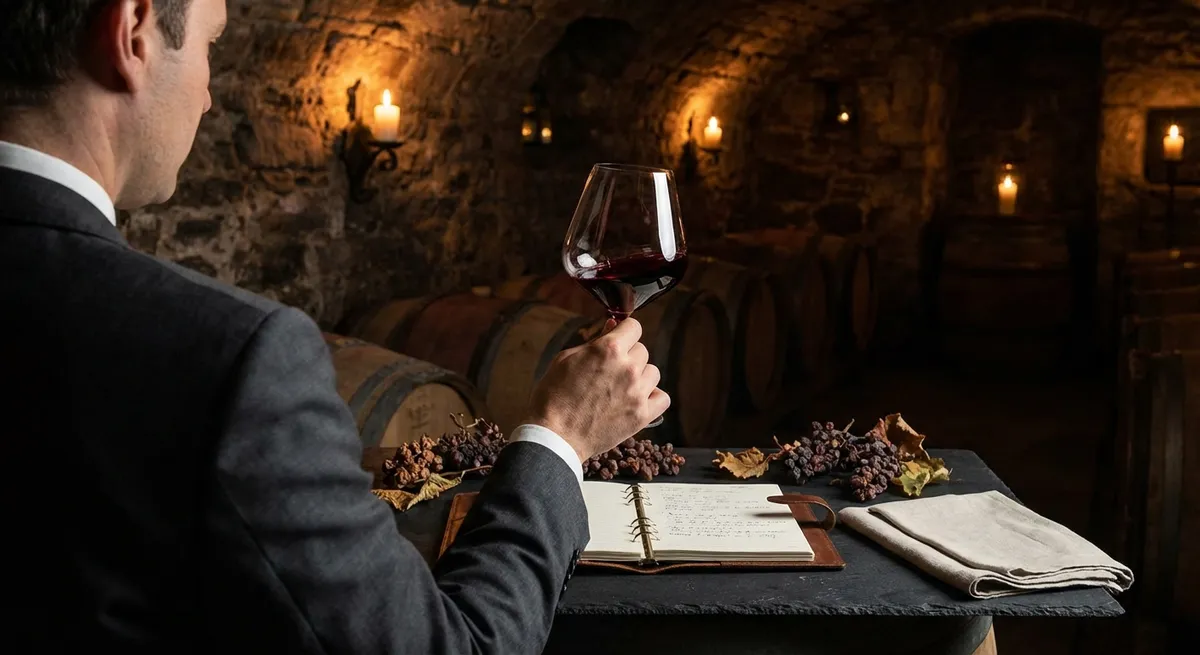
This temporal dimension becomes especially fascinating with older vintages. A mature wine can appear almost shy at first, then brighten and unfurl, revealing ephemeral aromas that may disappear as quickly as they arrive. Observing and even journaling this progression transforms tasting into something akin to watching a great performance—one you experience in real time, fully present to each fleeting act.
Site and Season in the Glass: Tasting the Precision of Place
“Terroir” is often reduced to a romantic buzzword, but for the refined taster, it is one of the most compelling elements to study. The question becomes: Can you sense not only the grape variety, but the character of the site and the nature of the season?
Compare, for instance, a cool-climate Pinot Noir from coastal Sonoma to one from a warmer inland site. Both may carry red fruit and subtle spice, but the coastal expression might feel more tensile, framed by higher acidity and a saline edge, as though the ocean air has imprinted itself on the wine. The warmer site may show riper fruit, a more generous mid-palate, and a softer structural profile.
Over multiple tastings and vintages, patterns emerge. Specific vineyard sites often show signatures: a chalky-textured finish in Chablis grown on Kimmeridgian limestone, or a distinctly smoky, flinty edge in certain Loire Sauvignon Blancs. By seeking out comparative tastings (same producer, different sites; same site, different vintages), you train your palate to detect not just “where” a wine is from, but how that place manifests in the glass—an insight that deepens the pleasure of every sip.
Silence Between Sips: Refining Your Palate Through Intentional Restraint
Advanced tasting is as much about what you don’t do as what you do. In thoughtfully curated tastings, some of the most revealing moments occur in the silence between sips—those unhurried instants of observation when the finish of the wine has room to speak.
Give the wine time to linger. Notice how long the flavors persist after you swallow or spit; count the seconds in quiet. A wine of true complexity often continues to echo with secondary and tertiary notes—bitter orange peel, cocoa, black tea, truffle, wet stone—well after the primary fruit has faded. That “tail” of flavor, both in length and intricacy, is one of the surest clues to a wine’s underlying quality.
Just as important is restraint in the number of wines tasted. Rather than racing through dozens of pours, a more refined approach might involve a focused flight of four to six wines explored at depth. By slowing down and allowing each glass its proper space, you create room for precision: subtle differences become visible, and your palate sharpens into a more analytical, perceptive instrument.
Cellar Imagination: Tasting a Wine’s Future, Not Just Its Present
For serious enthusiasts, the pleasure of tasting extends beyond the immediate experience to an act of projection: What will this wine become? Evaluating age-worthiness is a refined skill that blends sensory perception with an understanding of structure and balance.
Ask yourself: Does the acidity feel vivid and well integrated, ready to support evolution? Are the tannins firm but fine-grained, with enough tension to carry the wine forward without overwhelming it? Is the fruit concentration sufficient, not just in ripeness but in depth, to persist as primary notes gently recede and tertiary aromas—leather, mushroom, forest floor, dried flowers—emerge over time?
Some wines, particularly certain Rieslings, high-quality Cabernet Sauvignon, Nebbiolo, and structured Chardonnays, almost beckon for patience. When you taste them, you may sense they are currently in a “closed” or reticent phase, their true complexity still folded within the structure. Recognizing this latent potential allows you to build a cellar—large or modest—that functions less as a collection and more as a curated narrative of time, with each bottle scheduled for its moment of perfect expression.
Conclusion
At its most elevated, wine tasting is a highly attuned conversation with craftsmanship, place, and time. It is not about chasing superlatives or ostentation, but about cultivating a refined sensitivity to the details that others overlook: the grain of tannin, the shape of texture, the arc of evolution in the glass, the quiet persistence of the finish, and the latent future encoded in a young, tightly wound wine.
For the discerning enthusiast, each tasting becomes an intimate, meticulously observed experience—less an event and more a ritual. By leaning into these subtler dimensions, you move beyond the surface of aroma and flavor into a realm where every glass is an elegant, singular encounter with the extraordinary.
Sources
- Wine Tasting 101: How to Taste Wine Like a Pro – Wine Spectator - Offers foundational tasting structure and vocabulary that underpins more advanced techniques.
- Understanding Wine Structure – University of California, Davis - Academic perspective on tannins, structure, and their role in wine quality and aging.
- Terroir and the Winegrower – Institute of Masters of Wine - In-depth discussion of terroir and how site characteristics influence wine style and expression.
- Decanting and Aeration – Decanter Magazine - Explores how time and air affect a wine’s evolution in glass and decanter.
- How Wines Age – Wine & Spirit Education Trust (WSET) - Explains the structural components that enable wines to develop complexity over time.
Key Takeaway
The most important thing to remember from this article is that this information can change how you think about Wine Tasting.