The travel world’s gaze is turned skyward this week. As photographers and aurora-chasers share their most exquisite Northern Lights images—spotlighted in the newly announced 2025 Nature “inFocus” Photography Awards and first‑person features on “the best places and times to see the Northern Lights”—a familiar desire resurfaces among discerning travelers: to witness something truly rare, ephemeral, and unrepeatable.
What many don’t yet realize is how naturally this pursuit of the aurora’s fleeting beauty aligns with the most elevated forms of wine travel. In 2025, a quiet but notable trend is emerging at the intersection of dark-sky tourism, fine wine, and haute hospitality—from Icelandic tasting salons pouring volcanic reds under shimmering skies, to Nordic lodges curating micro‑pairings for guests returning from a midnight aurora chase.
For wine enthusiasts who crave both terroir and transcendence, this moment presents a rare opportunity: to design journeys where the sky becomes part of the tasting note. Below, explore five exclusive insights for crafting sophisticated wine experiences that resonate with the current global fascination for the Northern Lights—without ever losing sight of the glass in your hand.
1. Follow The Sky, Then The Cellar: Reimagining “Seasonality” In Wine Travel
As aurora experts remind the world this week, timing is everything: solar activity may be constant, but visibility hinges on darkness, weather, and latitude. The same temporal precision is increasingly redefining luxury wine travel.
Instead of planning a vineyard escape solely by harvest dates, the most discerning travelers now layer in celestial and atmospheric considerations. In northern-leaning wine regions—from coastal Oregon and Washington to the emergent cool‑climate vineyards of Scandinavia and the UK—high-end lodges are curating stays that align with peak dark-sky conditions, meteor showers, and even lunar cycles. A barrel tasting under a new moon, when the Milky Way is visible above the vines, delivers an emotional resonance no cellar lighting can imitate.
For enthusiasts inspired by the current wave of aurora photography, this means designing itineraries where the “golden hour” is no longer just for vineyard photos. Dusk becomes the prelude: a focused tasting of aromatic whites as the sky fades; a cellar visit timed precisely so guests emerge to a canopy of stars. The Northern Lights may remain elusive outside of high latitudes, but the principle is universal—let the sky dictate the schedule, then allow the cellar to complete the experience.
2. Volcanic Soul: Why Iceland And Nordic Wine Lists Are Having A Moment
In features about the best places to see the Northern Lights, Iceland, northern Norway, and Finnish Lapland are once again front and center. Yet what’s quietly evolving, and often overlooked, is the level of ambition in the wine programs that now accompany these aurora‑focused journeys.
In Reykjavík and along Iceland’s dramatic south coast, luxury properties are building cellar lists that lean into volcanic expression—Etna Rosso, Santorini Assyrtiko, Canary Island Listán Negro—creating a sensory bridge between the lava fields outside and the glass in hand. In Tromsø and Alta, upscale lodges are pairing Arctic char and reindeer with Burgundian Pinot Noir and German Spätburgunder, deliberately choosing wines whose tension, minerality, and cool-climate elegance mirror the landscape.
For the wine traveler, this is a particularly 2025 form of terroir: not tied solely to vineyard geography, but to geologic kinship. Under an aurora-lit sky, a vertical tasting of Etna’s north-slope crus feels less like an academic exercise and more like a conversation between distant but kindred landscapes. The best Nordic sommeliers are increasingly attuned to this narrative, guiding guests toward wines that make emotional sense in the polar night—wines whose structure, acidity, and mineral backbone stand up to the crystalline air and the stark, luminous horizon.
3. Dark-Sky Pairings: How Night Itself Is Becoming A Tasting Note
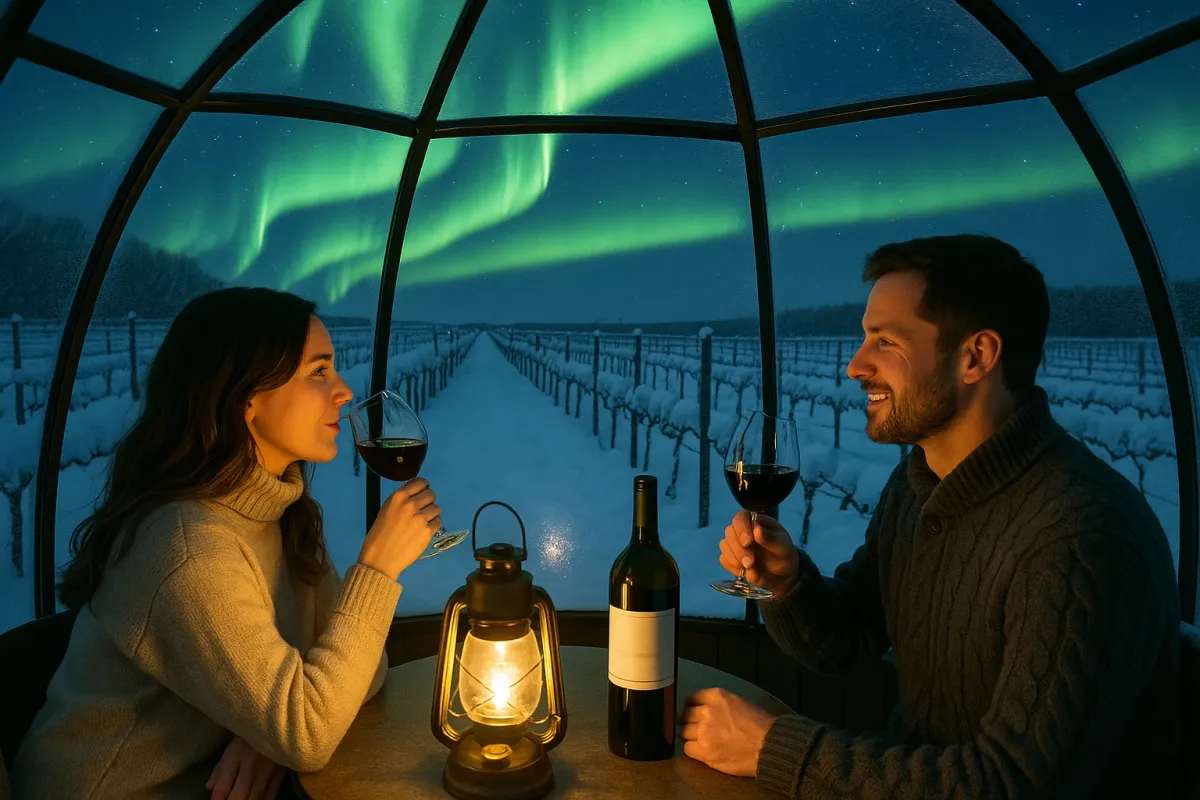
The surge of interest in night-sky experiences—fueled by viral aurora images and dedicated dark-sky travel guides—has begun to reshape the choreography of high-end wine service. In many destinations, the most coveted reservations are no longer at 7:30 p.m. in the dining room, but at 11:00 p.m. on the terrace, with blankets, heaters, and a thoughtfully curated flight.
Sophisticated programs are moving beyond the novelty of “stargazing with champagne” and into genuinely considered nocturnal pairings. Textural, lees‑aged sparkling wines to open the night while eyes adjust to the dark. Taut, saline whites to capture the cool edge of the evening air. Silky, low‑alcohol reds whose aromatics bloom gently in the cold, rather than heavy wines that numb the palate and the moment.
For the enthusiast, this is an invitation to think of darkness as an ingredient in the tasting. Temperature, humidity, altitude, and light pollution subtly alter how aromatics rise and flavors unfold. A grower Champagne that feels merely “precise” at lunch can become profoundly contemplative under a star-drenched sky. As travel media fixates on the aesthetics of the aurora, the most rewarding wine journeys will be the ones that treat the night itself as a legitimate, deliberate component of the experience.
4. From Sensor To Stemware: Tech-Forward Travelers, Old-World Bottles
The same technology enabling photographers to capture award-winning aurora images—high‑sensitivity sensors, AI‑assisted noise reduction, and advanced tracking—is shaping a new profile of luxury traveler: one who arrives with a mirrorless camera in one hand and a list of small producers in the other.
These guests tend to be data‑literate and trend-aware. They follow solar forecasts and Kp indices with the same intensity they apply to Burgundy allocation lists and grower Champagne releases. For them, a Northern Lights trip is incomplete without a cellar experience that feels equally precise and insider‑driven.
Leading properties in aurora hotspots are responding by elevating their wine curation beyond glossy labels. Expect tightly edited lists emphasizing:
- Single-vineyard bottlings whose micro‑terroirs can be discussed with the same granularity as camera settings.
- Minimal‑intervention producers whose transparency and authenticity resonate with travelers accustomed to RAW image files and unfiltered views.
- Back‑vintage allocations that offer a counterpoint to the hyper‑modernity of night-sky imaging—reminding guests that while technology gallops ahead, certain pleasures remain reassuringly analogue.
The most memorable experiences arise when a sommelier speaks the same language of nuance and calibration as an astrophotographer. A conversation that begins with shutter speed and ISO can evolve seamlessly into discussions of fermentation temperature, oak regimen, and the patience required for both a long exposure and a long élevage.
5. Designing “Aurora-Adjacent” Wine Itineraries Without Leaving The Vines
Not every wine lover will fly to the Arctic Circle, no matter how mesmerizing the latest aurora photographs may be. Yet the principles behind these journeys—chasing fleeting beauty, embracing the night, listening to the landscape—are easily translated into more traditional wine regions.
In Europe, dark‑sky reserves near Spanish, Portuguese, and southern French vineyards are quietly becoming the backdrop for after‑hours tastings and private astronomer‑led sessions, with the glass never far from reach. In North America, Willamette Valley, Okanagan, and high‑desert regions are collaborating with observatories and astro‑guides to create itineraries where barrel samples and telescope sessions share equal billing.
For wine enthusiasts, this is the most actionable insight of all: you do not need the aurora overhead to craft an aurora‑inspired wine journey. Seek out regions where light pollution is minimal, where vineyards sit under genuinely dark skies, and where hospitality partners understand that sophistication lies in orchestration, not excess. A library tasting followed by a midnight walk through silent rows of vines—stars blazing above, a final sip of cool, mineral white in hand—can be every bit as moving as a once‑in‑a‑lifetime solar storm.
Conclusion
As the world pauses to admire the latest Northern Lights photography and to read first‑person accounts of chasing auroras across Nordic skies, a deeper truth emerges for the wine traveler: the most luxurious experiences are those that honor rarity, transience, and context.
In 2025, the finest wine tours are no longer confined to daylight cellar doors and predictable tasting flights. They lean into the night, converse with the landscape, and borrow inspiration from the very forces now captivating the global imagination. Whether you are raising a glass beneath actual auroras or under a perfectly dark, star‑washed rural sky, the aim is the same: to let each sip feel as singular and unrepeatable as the sky above you, and to curate journeys where the memory lingers long after both the bottle and the lights have faded.
Key Takeaway
The most important thing to remember from this article is that this information can change how you think about Wine Tours.