There is a quiet revolution unfolding between the rows of vines. As the world obsesses over supersized moons and award‑winning wildlife shots, the conversation about what makes a landscape truly unforgettable is shifting. The recent viral acclaim for “Nature Photographer of the Year” and the breathtaking, unedited lunar images now circulating across social media have done more than fill feeds with beauty—they’ve raised the bar for how we expect to experience the natural world in person. For discerning wine travelers, that means the vineyard visit is no longer just about what’s in the glass, but how the estate frames its own terroir as living art.
Luxury wine destinations from Napa to the Douro, from Stellenbosch to Steiermark, are watching closely as photographers capture pristine, unmanipulated moments of nature and share them with millions. The same visual literacy that allows people to instantly distinguish between Photoshopped fantasy and authentic light has arrived in the tasting room. Today’s premium estates are curating views, crafting sunset tastings timed to the golden hour, and collaborating with photographers who once chased auroras and supermoons, all to create vineyard experiences that feel as honest—and as cinematic—as the best nature photography.
Below, five exclusive insights into how this new, image‑driven sensibility is quietly transforming the high‑end vineyard visit.
The Golden Hour is the New Reservation Time
As photographers celebrate unedited, lens‑only images of a magnified moon or a mist‑draped forest, vineyard estates are rethinking the clock. The default 2 p.m. tasting is giving way to appointments orchestrated around light. In Napa and Sonoma, flagship producers are adding “golden hour seatings” that begin 60–90 minutes before sunset, allowing guests to watch the vineyards move through three distinct light palettes while they progress through a flight. In Portugal’s Douro Valley, quintas perched over the river now coordinate boat arrivals so guests step onto the terrace just as the slate terraces ignite in copper hues, echoing the drama currently winning global photography awards.
This isn’t about Instagram alone. Winemakers report that the same low, raking light that beguiles photographers also reveals textural details in the landscape—old stone walls, cover crops, the subtle slope of a parcel—that deepen a guest’s understanding of terroir. Meanwhile, estates in regions like New Zealand’s Central Otago are partnering with local photographers to advise on sightlines and timing, effectively treating daylight as a luxury ingredient, as carefully calibrated as oak or lees contact. For the traveler, the implication is clear: the most coveted slots at top wineries are now defined less by exclusivity and more by when the light is at its most eloquent.
From Cellar Tours to “Field of View” Walks
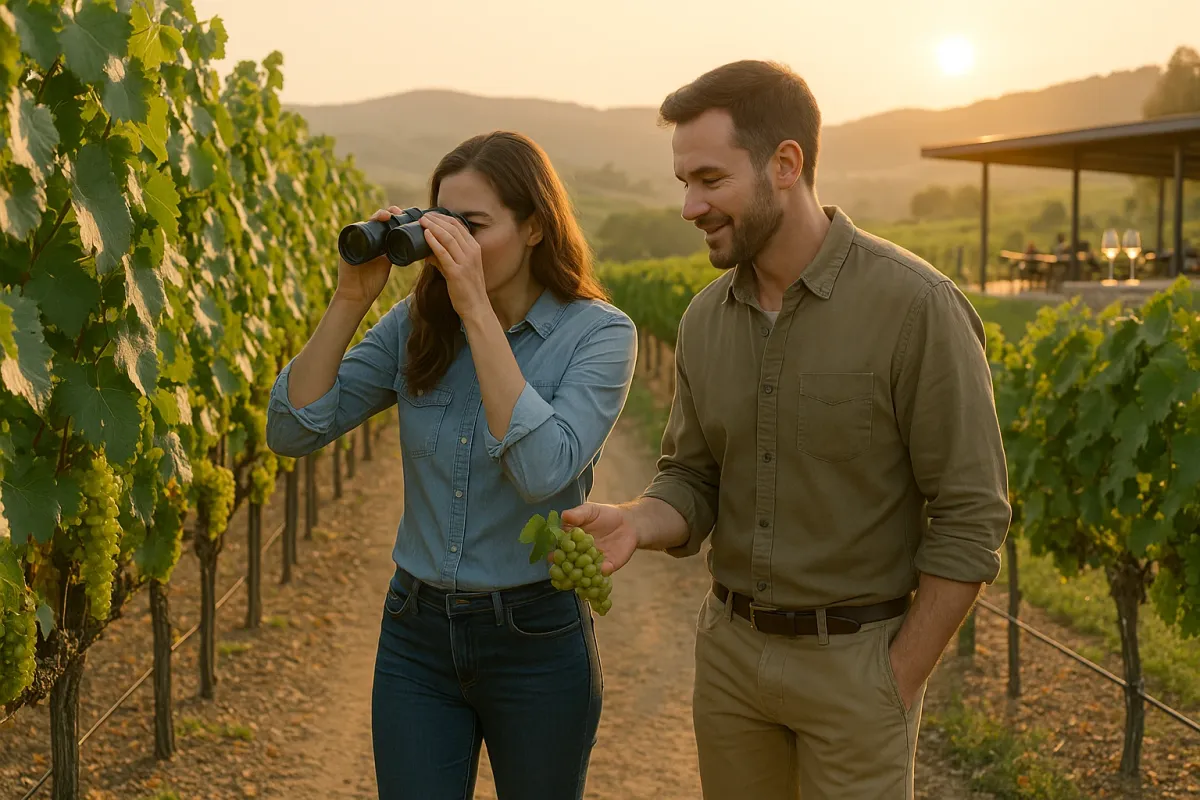
The rise of nature photography competitions, with their emphasis on composition and perspective, is inspiring a new kind of vineyard tour—one that moves beyond the traditional barrel room circuit. In Bordeaux and Tuscany, high‑end châteaux are introducing “field of view” walks led jointly by a viticulturist and a landscape‑trained photographer. Guests are guided to three or four carefully chosen vantage points: the crest of a slope where the aspect shifts by a few degrees, a low point where cold air pools, a promontory that reveals subtle changes in canopy density.
At each stop, visitors are encouraged to frame the scene as a photographer might—considering foreground, horizon line, and the direction of the light—while the vineyard team explains how those same visual cues translate into ripening curves, disease pressure, and harvest decisions. In Burgundy, some domaines are even supplying guests with compact, high‑quality lenses to clip onto their phone cameras for the duration of the walk, echoing the gear‑light but lens‑serious ethos of the photographer who recently went viral for enlarging the moon without digital manipulation. The result is a tour that feels simultaneously more technical and more poetic, inviting guests to see the vineyard not as a backdrop, but as a finely calibrated visual instrument.
Nightfall Tastings: When the Sky Becomes Part of the Terroir
The surge in public interest around astrophotography and those astonishing “no Photoshop” lunar images has emboldened a growing number of vineyards to extend their hospitality into the night. In regions blessed with dark skies—think South Africa’s Swartland, Spain’s Ribera del Duero, or the high plateaus of Argentina’s Uco Valley—wineries are introducing stargazing tastings that treat the nocturnal sky as a dimension of terroir.
These experiences often begin with a restrained, twilight aperitif among the vines, then move to a landscaped terrace where telescopes, guided by local astronomers or astrophotographers, frame the moon, planets, and constellations with the same precision that a sommelier uses to frame a grand cru. Estates inspired by the recent viral moon imagery are investing in serious optics: apochromatic refractors, motorized mounts, and curated “celestial pairings,” such as a saline, high‑altitude Chardonnay alongside a close‑up of the moon’s cratered mare, or a brooding Malbec poured as the Milky Way emerges in astonishing clarity.
For guests, the experience is both grounding and expansive: the same soils that give the wines their structure are understood as part of a much larger cosmic narrative. And crucially, this is not a tech spectacle; the commitment to minimal post‑processing in leading astrophotography circles is mirrored in the winery’s ethos—low light pollution, minimal artificial illumination, and an emphasis on direct, unmediated seeing.
Lens‑Crafted Architecture: Tasting Rooms Designed Like Viewfinders
As award‑winning nature photographs trend across platforms, collectors and wine travelers are becoming more visually exacting. Wineries are responding by treating architecture less as a statement piece and more as a precision frame for the landscape. In Oregon’s Willamette Valley, new tasting rooms are being designed with elongated, low‑slung windows that mimic panoramic aspect ratios favored by landscape photographers. In Chile’s Casablanca and San Antonio Valleys, glass‑fronted viewing decks are oriented with almost obsessive accuracy toward the direction of prevailing ocean fogs and sunrise angles, so guests can watch the climatic drama that defines the wines.
Some European estates are collaborating directly with photographers who have been shortlisted in major nature competitions to advise on sightlines, glare control, and how reflections can be harnessed rather than fought. In Austria’s Wachau, one estate famously scrapped plans for a dramatic, sculptural façade after consultations revealed it would interrupt a historically significant hillside view; instead, they built discreet, terraced tasting pavilions that echo the stepped vineyards, each one framing a composed “shot” of the Danube and surrounding slopes. The guiding principle is borrowed straight from the most compelling nature imagery going viral today: no unnecessary filters, minimal visual noise, and a relentless focus on what the landscape already does perfectly.
From “Photo Ops” to Visual Provenance
The culture of viral imagery has made audiences more skeptical—and more discerning. In the same way viewers can now spot over‑edited nature photos, wine enthusiasts increasingly recognize manufactured “photo ops” that feel disconnected from the soul of the place. In response, thoughtful wineries are shifting from staged backdrops to what might be called visual provenance: allowing guests to trace, with their own eyes, the journey from landscape to bottle.
In practice, this means the camera‑friendly moments are no longer the postcard gazebo, but the tension wire where a particular clone is trained, the weathered trunk of an 80‑year‑old vine, or the precise line where limestone gives way to clay. Inspired by photo essays that document ecosystems with journalistic clarity, some high‑end estates in regions like Champagne and the Mosel are installing subtle, almost museum‑like placards near key viewpoints, explaining not just the grape variety but the geological, climatic, and historical context visible in the frame. Many now offer guests a digital “visual map” afterward—a curated series of images from the visit, lightly edited for exposure but never altered, mirroring the ethos of those viral “no Photoshop” lunar photographs.
This approach respects a new kind of luxury traveler: one who prizes authenticity over spectacle, and who understands that a single, honestly composed image of a parcel, taken in the right light, can say more about a wine’s character than a dozen marketing slogans.
Conclusion
As nature photography ascends to cultural prominence—winning global awards, dominating feeds, and teaching us to see again—its influence is quietly reshaping the world of high‑end vineyard visits. The estates that will define the next decade of wine tourism are not merely pouring rarities; they are orchestrating light, framing horizons, and inviting guests to experience terroir with the same attentiveness a photographer brings to a once‑in‑a‑lifetime shot.
For the wine traveler, this is an extraordinary moment. The vineyard is no longer just a setting to be admired between sips—it is a living composition, evolving from golden hour to moonrise, from wide‑angle vista to intimate close‑up of an ancient vine. And the finest wineries in the world are learning, in real time, how to become nature’s most elegant lenses.
Key Takeaway
The most important thing to remember from this article is that this information can change how you think about Vineyard Visits.