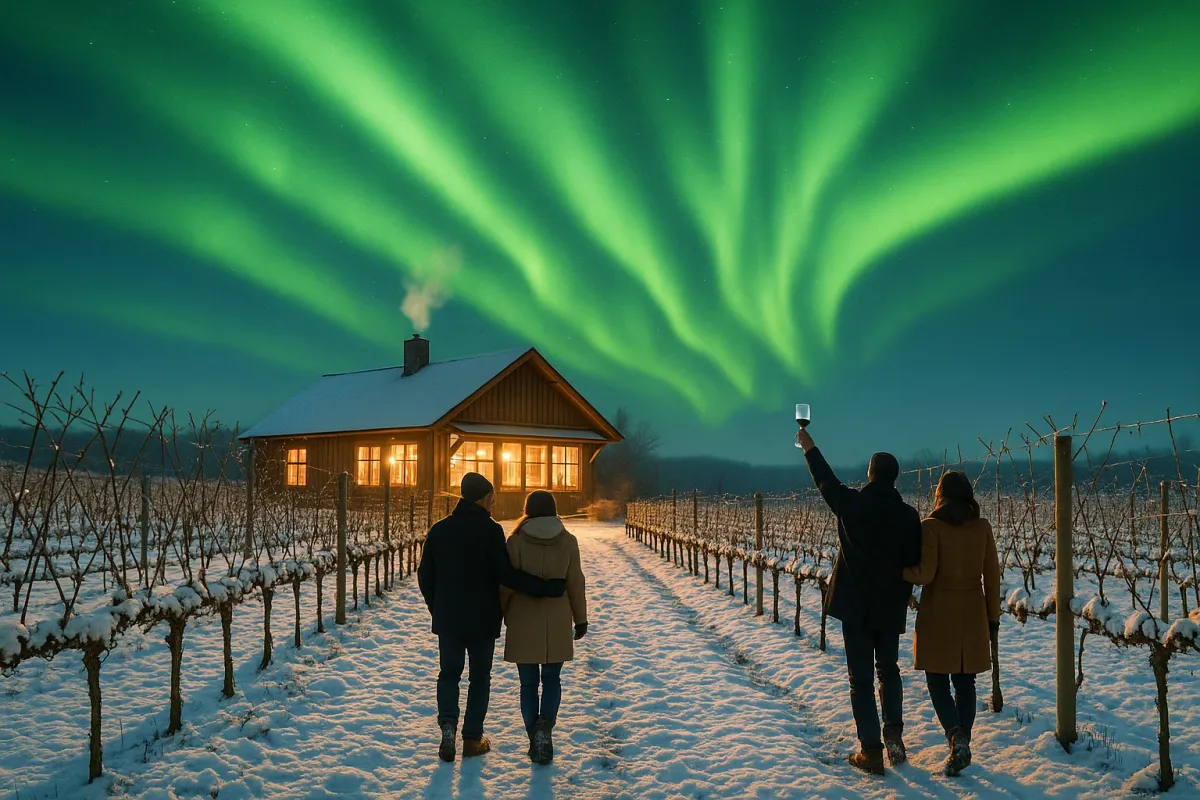
For travelers who collect experiences the way others collect labels, a quiet shift is underway at the top of the world. As today’s travel media buzzes with guides on “the best places and times to see the Northern Lights” across Norway, Iceland, and Finnish Lapland, a different kind of pilgrim is charting a parallel route: the wine lover who wants both aurora and appellation on the same itinerary.
While the Arctic remains far from traditional wine country, the surge of luxury aurora tourism—eco-lodges with glass domes, curated astrophotography tours, and Michelin-leaning Nordic cuisine—is subtly reshaping how high-end travelers think about seasonality, light, and landscape. That same sensibility is now informing a new generation of vineyard visits, from cool-climate estates in northern Europe to high-latitude experimenters in Scandinavia and Canada. The question sophisticated wine travelers are asking right now is no longer “Where should I go?” but rather “When, and under what sky?”
Below, five timely, aurora-inspired insights for wine enthusiasts planning their next vineyard escape in a world newly obsessed with northern light.
1. The “Aurora Mindset” Is Elevating Nightfall in the Vineyard
The current wave of Northern Lights coverage—often emphasizing darkness windows, moon phases, and light pollution maps—is quietly teaching luxury travelers to think in terms of sky conditions as carefully as they do hotel categories. That awareness translates elegantly to vineyard country, where night has long been treated as an afterthought rather than an asset.
Forward-thinking estates in cooler regions like Austria’s Wachau, Germany’s Mosel, Oregon’s Willamette Valley, and Canada’s Okanagan are beginning to lean into a more celestial approach. Private, late-season tastings are being timed to coincide with unusually clear autumn skies; some are pairing verticals of cool-vintage Pinot Noir or Riesling with guided stargazing, complete with astronomers on site and blankets laid out between the rows. For guests who have recently returned from Lapland’s glass-roofed cabins or Icelandic sky domes, this feels like a natural extension of that aurora mindset—substituting the neon greens of the north for a more subtle quilt of constellations over vineyards turning gold.
The premium touch lies in choreography: dimmed architectural lighting that respects the stars, low-intervention soundscapes (crickets, not playlists), and glassware choices that disappear in the dark. As aurora tourism normalizes the idea that night itself can be the destination, expect the most refined wine estates to create their own nocturnal rituals among the vines.
2. High-Latitude Experiments Are Becoming the Connoisseur’s Detour
As aurora hunters debate whether Tromsø, Abisko, or remote Finnish Lapland offers the most reliable Northern Lights this season, wine collectors are quietly watching something else: the rise of ambitious, high-latitude winemaking projects that mirror their northern itineraries.
While Scandinavia is far from dethroning Burgundy, experimental vineyards in southern Sweden, Denmark, and coastal Norway are drawing the curiosity of travelers already heading north for the lights. Hybrid and early-ripening varieties—Solaris, Rondo, and even trial plantings of Pinot Noir and Chardonnay—are being coaxed into unexpectedly elegant expressions in places that, a decade ago, would have been dismissed as impossible.
For the sophisticated visitor, the allure here is not trophy status but narrative: the same latitude that offers a front-row seat to the aurora also demands meticulous attention to canopy management, frost protection, and every fleeting hour of sunlight. A day spent walking wind-brushed rows on a Danish island, followed by a tasting of bracing, sea-kissed sparkling wines, feels like the vinous counterpart to waiting for the sky to ignite over a frozen lake in Norway. Both experiences reward patience, sensitivity to weather, and an appetite for the extraordinary margins of possibility.
3. Seasonality Is Being Redefined by Darkness, Not Just Harvest
The current crop of Northern Lights features reiterates a single truth: timing is everything. Travelers are being coached to aim for the darkest winter months, align with geomagnetic activity forecasts, and embrace the shoulder weeks when crowds thin but conditions peak. This emphasis on “the right darkness at the right time” is beginning to influence how discerning guests think about vineyard travel.
Traditionally, harvest has anchored the wine tourism calendar: September in Bordeaux, October in Piedmont, late autumn in Napa. Now, a parallel rhythm is emerging. Estates in regions with pronounced diurnal shifts—think northern Spain’s Ribera del Duero, Alto Adige in Italy, or Tasmania in Australia—are finding renewed interest from guests who are deliberately seeking cooler, deeper evenings rather than sun-drenched afternoons.
Imagine a winter visit to an estate in the hills above Bolzano: snow flanking the terraces, a twilight cellar tour by candle-glow, and a tasting of mountain whites and late-harvest specialties as the sky darkens by late afternoon. For the aurora-aware traveler, the pleasure is in the gradient from last visible vineyard contour to inky night, a transition now perceived with the same attentiveness formerly reserved for coastline sunsets.
4. Glass, Reflection, and the New Architecture of Wine Travel
Aurora lodges from Iceland to Finnish Lapland are suddenly everywhere in the travel press, their glass igloos and panoramic suites designed to erase the boundary between guest and sky. This architectural language—transparent, reflective, almost reverent toward the heavens—is migrating south, reshaping the expectations of design-savvy wine travelers.
Some of the most compelling new tasting rooms and vineyard villas are borrowing from this aesthetic: floor-to-ceiling glazing that frames not just neat ranks of vines, but the full dome of the sky above them; reflective water features that capture both trellises and twilight; elevated decks oriented with almost astronomical precision to catch both sunset and the first emerging stars. In cooler-climate estates, glass-roofed conservatories are hosting winter tastings where guests can watch frost creep along the edges of the vineyard while remaining cocooned in candlelit warmth.
For oenophiles who have lain awake in Lapland’s glass cabins hoping for a flicker of green across the night, this feels instantly intuitive. The vineyard is no longer just earth, slope, and aspect; it is also the theatre of the sky. A perfectly poised Chardonnay shows differently when tasted under the first indigo of evening than under the blunt white of noon, and elite estates are beginning to design spaces that make that difference feel intentional, not incidental.
5. The New Luxury: Stillness, Patience, and the Long Pour
If there is one lesson Northern Lights travelers are broadcasting across social media this season, it is that genuine spectacle cannot be rushed. Hours in the cold, cameras at the ready, nothing happening—until, all at once, everything does. That culture of stillness and anticipation is strikingly aligned with the most thoughtful forms of wine appreciation, and the synergy is not lost on the world’s more contemplative wineries.
Expect to see an increase in experiences that are deliberately paced, almost meditative in structure. A sunset walk through the vines, followed by a slow, unhurried progression through a carefully chosen flight—perhaps multiple vintages of the same single-vineyard bottling—served at a pace that mirrors the way one watches a sky slowly change. Rather than rushing through half a dozen wines in 40 minutes, the emphasis is on remaining with each glass long enough to register how it evolves as the air cools, the light fades, and the estate falls into nighttime quiet.
For travelers returning from aurora hunting in Norway, Sweden, or Iceland, this alignment is profound: both experiences honor the long wait, the subtle shift, the moment when something reveals itself only because you stayed. In a world of instant everything, this is the new face of luxury—time granted, not taken; silence curated as carefully as the cellar.
Conclusion
As today’s headlines celebrate the best Arctic vantage points for the Northern Lights, a more discreet revolution is taking place in the vineyards. The same travelers plotting midnight crossings of frozen lakes in search of green fire are beginning to demand vineyard visits that honor light, darkness, and seasonality with similar reverence. High-latitude experiments, glass-wrapped tasting rooms, and elegantly choreographed nocturnal experiences are quietly redefining what it means to visit a winery in 2025.
For wine lovers paying attention, the message is clear: your next great tasting may not be defined solely by the slope beneath your feet, but by the sky above your glass. And in this new era of aurora-inspired travel, the most memorable vineyard moments will belong to those willing to arrive later, linger longer, and let the night itself become part of the terroir.
Key Takeaway
The most important thing to remember from this article is that this information can change how you think about Vineyard Visits.