Some vineyards impress at first glance; others unfold slowly, revealing themselves only to those who know what to watch, taste, and listen for. A discerning vineyard visit is less about ticking estates off a list and more about attuning yourself to the subtle choreography of land, light, and labor. For travelers who prefer their experiences measured not in selfies but in seconds of silence between sips, a vineyard can become a private observatory of craft and place.
This is an exploration of vineyard visits at their most refined: not rushed tastings, but immersive encounters. Below are five exclusive insights that reward the observant guest—details that transform a pleasant outing into a deeply informed, quietly luxurious experience.
Reading the Vineyard Before You Taste
Long before you reach the tasting room, the vineyard is already speaking. An attentive guest will pause—ideally with a guide who is genuinely involved in viticulture—to decode the landscape. Notice the angle of the slopes: steeper parcels shed water more easily and often yield smaller, more concentrated berries. Observe soil variations underfoot; gravelly, limestone, or volcanic plots will each leave a distinct imprint on the wines.
Pay attention to row orientation. Vines aligned for optimal exposure to morning rather than harsh afternoon sun often produce fruit with more restrained ripeness and finer aromatics. Look at canopy management: are leaves carefully trimmed to dapple the fruit, or left dense and luxuriant? The structure of the canopy influences everything from phenolic ripeness to the precision of acidity.
The most meaningful question to ask is not, “How many acres do you farm?” but, “Which parcels do you personally consider your most challenging?” The answer reveals where the winemaker’s energy and anxiety live—and those are often the blocks that produce the most intriguing wines. By the time you raise your first glass, you will already carry a mental map of the vineyard, and each sip will feel less anonymous, more anchored in place.
The Art of Arriving at the Right Moment
Sophisticated wine travelers do not simply ask, “When are you open?”; they ask, “When does your vineyard feel most itself?” Different seasons and windows of the day radically alter what you can perceive. A dawn or late-morning visit in high summer can expose the intricate balance between heat and shade, revealing how vines manage stress. In cooler climates, a late afternoon walk might dramatize the way temperatures fall and aromas in the vineyard air sharpen.
Visiting during flowering or veraison (when grapes change color) allows a rare look at the vineyard’s internal calendar. Flowering reveals vulnerability and the stakes of weather risk; veraison shows the moment fruit becomes an object of intense scrutiny and triage. Around harvest, a premium estate may allow you to observe sorting tables at work—seeing which berries are rejected says more about a producer’s standards than any marketing brochure.
Timing also means understanding when a cellar is least performative. Between major seasonal tasks, staff are less hurried and more candid. This is when you can ask probing questions about difficult vintages, experiments that failed, or parcels that may never be commercialized. Arriving at the right moment is not about avoiding crowds; it is about catching the estate in an unguarded, deeply authentic rhythm.
Following the Invisible Routes of Precision
Behind every polished tasting is a network of invisible routes—ways in which fruit, decisions, and data move through the estate. The refined visitor pays attention to these often-overlooked lines of precision. Ask how fruit travels from vineyard to cellar: is it hand-harvested and moved in small crates to prevent crushing, or transported in bulk bins? Are there multiple picking passes through the same block to capture different ripeness levels for blending, or a single all-at-once harvest?
Within the cellar, note the diversity of vessels: stainless steel, concrete, large neutral foudres, small barriques, amphorae. Each implies a philosophy of texture and oxygen management. Producers who invest in different fermentation vessels for distinct parcels are often pursuing microscopic shades of character that you will later detect in the glass as differences in tension, volume, or length.
The truly revealing question is, “What do you monitor most obsessively?” For some, it is phenolic ripeness; for others, dissolved oxygen, volatile acidity, or ambient yeast behavior. Data-driven estates may show you mapping tools, drone imagery, or moisture sensors. More traditional properties may point instead to handwritten vineyard logs. Both extremes can produce profound wines—but each reveals how precision is defined and pursued on site. Observing these invisible routes gives you a privileged view of the estate’s intellectual and technical backbone.
Listening for the Estate’s Unfinished Experiments
Every serious vineyard and winery is, in some corner, an unfinished thought. While the public story is polished—heritage, terroir, flagship cuvées—the most illuminating aspect is often what has not yet been released. A guest attuned to quiet details will gently steer conversation toward ongoing experiments and unresolved questions.
Look for small, unlabeled barrels or discreet corner tanks. Ask, “Is there anything you’re working on that you’re not ready to bottle or talk about widely?” You may learn of parcel-specific micro-vinifications, alternative pruning trials, regenerative agriculture plots, low- or no-sulfur trials, or tentative forays into different cooperages. These projects often exist in very small volumes and are rarely poured for casual visitors.
When invited, tasting from barrel or tank is not simply a novelty; it is an education in trajectories. You are glimpsing the wine mid-sentence, learning to recognize structural elements—acidity, tannin grain, aromatic precursors—before they harmonize. This teaches your palate to anticipate evolution in bottled wines as well. Understanding what a producer chooses not to bottle, or what they are still questioning about their terroir, is one of the clearest signs of intellectual honesty and long-term ambition.
Curating Your Own Vocabulary of Place
The most rewarding vineyard visits are those that refine your personal language for wine. Instead of relying only on standard tasting notes—cherry, citrus, minerality—consider anchoring your impressions in the estate’s specific realities. After walking the vineyards, touching the soil, and hearing the producer’s priorities, let that physical knowledge shape how you describe the wines.
If you tasted berries straight from the vine, recall how their acidity and tannin compared to the finished wine. If you noticed a persistent coastal wind on the hillside, consider how that translates into lift, salinity, or aromatic clarity. A slope that forced you to lean forward as you walked may later be echoed in wines that feel taut, vertical, almost architectural on the palate.
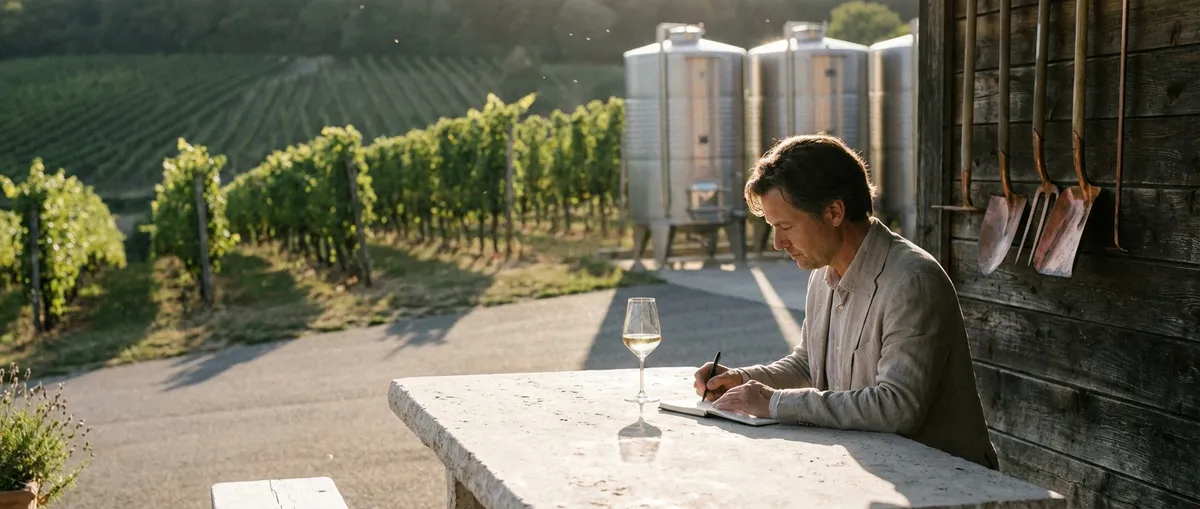
Bring a small notebook and, instead of copying the estate’s technical sheet, record your own sensory intersections: “north-facing parcel = leaner mid-palate, finer tannins,” or “older vines on shallow soils = intensity without weight.” Over time, this vocabulary of place allows you to recognize signatures across vintages and even across regions. You move from general admiration—“this is a beautiful wine”—to something more exacting and quietly gratifying: “this wine is a lucid translation of that specific slope at that particular moment in its life.”
Conclusion
A vineyard visit at its highest level is less about indulgence than about attention. It is a study in how land becomes liquid narrative, how countless small choices aggregate into something that feels inevitable in the glass. By reading the vineyard before you taste, arriving at the right moment, tracing the estate’s invisible routes of precision, seeking out its unfinished experiments, and cultivating your own vocabulary of place, you step beyond the role of visitor and into that of informed interlocutor.
In this slower, more deliberate mode of travel, vineyards cease to be mere backdrops for tasting rooms. They become living, evolving texts, and your journey through them a quietly luxurious act of interpretation—one that lingers long after the last bottle is poured.
Sources
- UC Davis Viticulture and Enology – Overview of viticulture practices, canopy management, and vineyard factors influencing wine quality
- Institute of Masters of Wine – Vineyard Management – Authoritative insights into site selection, pruning, harvest decisions, and their impact on wine style
- Wine Institute – Sustainable Winegrowing Practices – Details on precision, sustainability, and experimental approaches in modern vineyards
- Cornell University – Terroir and Vineyard Site Selection – Discussion of terroir, slope, soil, and climate relationships in vineyard expression
- Decanter – How to Taste from Barrel – Explains what barrel samples reveal about unfinished wines and producer decisions
Key Takeaway
The most important thing to remember from this article is that this information can change how you think about Vineyard Visits.